
A few months ago, I talked to a therapist who had built a genuinely excellent 8-week program. Great structure. Real results with her pilot clients. A waitlist forming organically.
She still hadn’t launched it.
Not because the offer wasn’t ready. Because she wasn’t ready — specifically, she couldn’t settle on a price without feeling like a fraud, so she kept “refining” the curriculum instead. Three months of refining a program that was already good enough to sell.
If you work in coaching, therapy, or wellness, I’d bet you’ve felt some version of this. And I don’t think it’s a confidence problem in the way we usually talk about confidence. It’s a sequencing problem.
We ask “am I ready?” when we should be asking “what haven’t I decided yet?”
Here’s what I mean.
Most service providers treat pricing as a feeling — something you either have the nerve to do or you don’t. So when the number feels scary, it seems like evidence you’re not ready, and the instinct is to go back and make the offer even better, hoping that eventually it’ll feel obvious.
It never feels obvious. I’ve watched brilliant practitioners underprice themselves for years waiting for a feeling that isn’t coming.
What actually works is smaller and less romantic: you make the pricing decision the same way you’d make any other business decision — with information, not vibes.
Three questions that do more than any amount of mindset work:
1. Who is this specifically for? Not “busy professionals.” Not “women who want to feel better.” If you can’t name the person’s actual situation in one sentence, the price will always feel arbitrary, because you haven’t defined what you’re actually solving.
2. What does this problem cost them if it goes unsolved? This is the number your price should be anchored to — not your hourly rate, not what you’d feel comfortable charging a friend, not what the person down the street charges. What is it costing your client, in time, money, or wellbeing, to keep living with this problem?
3. What would make this an easy yes? Not cheaper. Clearer. Payment plans, tiered options, a clean explanation of what’s actually included — these solve more hesitation than discounting ever will.
None of this requires new confidence. It requires a process you can follow on a day when your confidence is completely absent — which, if you run a service business, will be most days.
This is exactly why I built The Launch-Ready Worksheet.
It’s a 10-step guided worksheet for coaches, therapists, and wellness professionals who have an offer (or the idea for one) and keep delaying the launch. It walks through validating the offer, designing the client journey, pricing with actual logic instead of guesswork, and building a calm, realistic launch timeline — so the decisions get made on paper, before they have to get made under pressure.
It won’t make pricing feel exciting. But it will make it finished — which is the thing that actually gets offers out into the world.
If you’re sitting on a program, a package, or an idea you haven’t launched because the pricing conversation with yourself keeps stalling, that’s not a sign you need to wait longer. It’s a sign you need a better sequence of questions.
The worksheet is linked in the comments. If you’re mid-launch-limbo right now, I’d genuinely love to hear where you’re stuck — pricing, timing, or something else entirely.
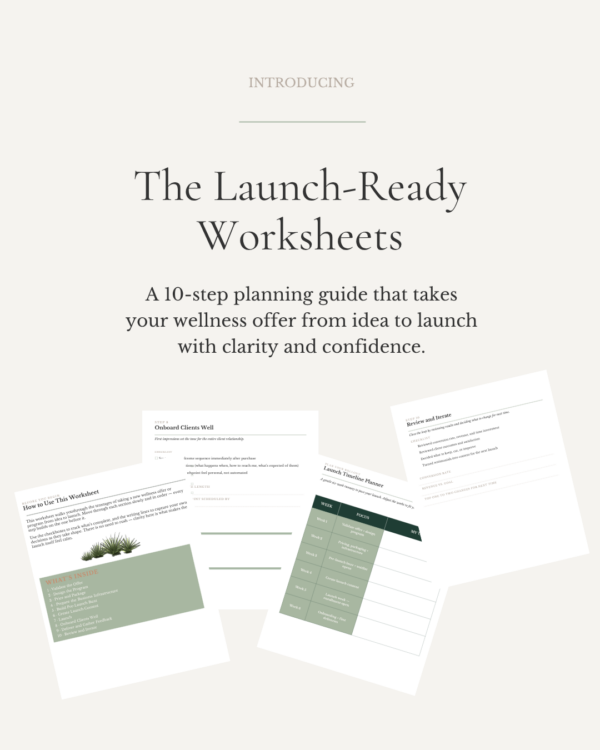
Launch Ready Worksheet
A calm, guided worksheet for launching your next offer with clarity instead of chaos. Ten steps, beautifully designed, to help you validate, price, and launch without the overwhelm.
No responses yet